
News List
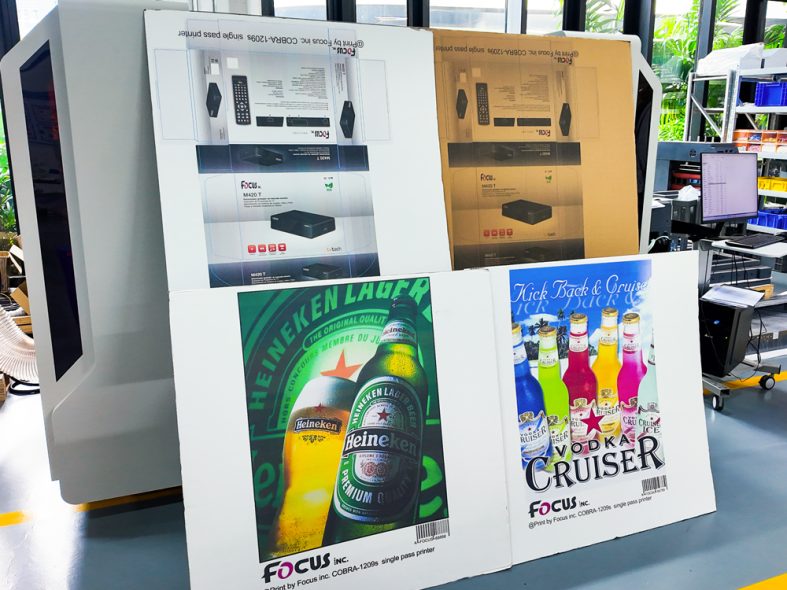
The global packaging and label printing industry has entered a clear replacement cycle. For decades, factory owners followed a fixed production rule. They chose web offset printing for large-batch orders and common digital devices for small-batch custom jobs. However, authoritative decade tracking data from Smithers and 2026 LFR industrial printing economic surveys have completely overturned this traditional industry pattern. Modern industrial single pass inkjet printing is rapidly squeezing web offset market share, thanks to its flexible production mode, lower comprehensive operating costs and continuous equipment performance upgrades.
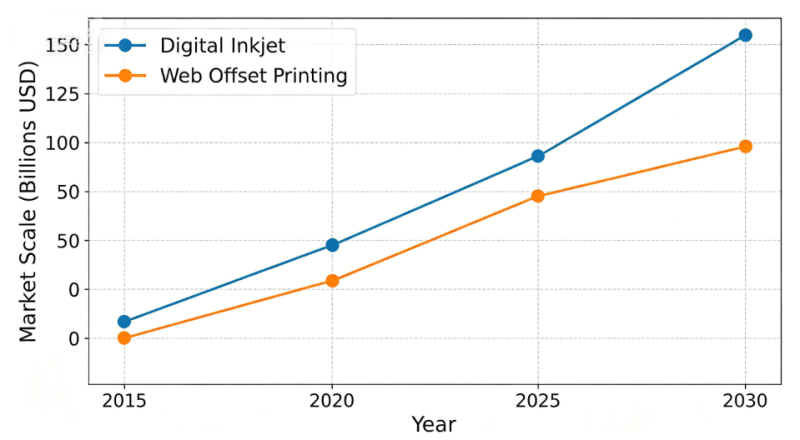
The global printing market pattern has undergone a complete reversal from 2015 to 2025. In 2015, web offset printing dominated mass production with a market size of $940 billion. Digital inkjet only reached $490 billion and was limited to short-run customized orders.
In 2025, digital inkjet market value doubled to $1080 billion, with an annual growth rate of 8.2%. In contrast, web offset printing dropped to $620 billion, declining 4.1% per year. Industry forecasts show digital inkjet will hit $1360 billion by 2030, while web offset will further shrink to $530 billion.
In European, Southeast Asian and Middle Eastern packaging markets, inkjet printing has occupied over 60% of short-to-medium batch custom orders. Brand packaging iteration cycles have shortened to 3–6 months, making flexible inkjet production more suitable for current market demands.
Many factory owners only compare single ink costs and ignore hidden losses. Authorized factory account statistics show web offset requires complete CMYK plate making and 2–4 hours of debugging. Its frequent order-switching waste rate reaches 4%–7%.
Industrial single pass inkjet needs no plates. It supports file direct printing and finishes order switching within 10 minutes. The overall production waste rate remains stable at 0.8%–1.3%.
In terms of labor and site costs, web offset requires 4–6 operators and independent plate rooms. Equivalent single pass inkjet lines only need 1–2 workers and save 40% of warehouse space. More importantly, inkjet on-demand production reduces inventory scrap loss from 3.1% to 0.7% of total revenue.
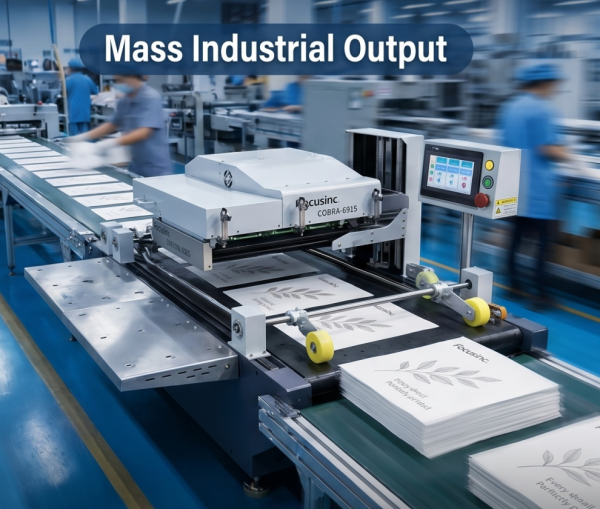
Early inkjet devices were limited by insufficient speed and unstable color rendering, restricting their application to only small-batch orders. New-generation industrial single pass printers have achieved comprehensive upgrades in running speed and printing precision. Equipped with advanced UV ink systems and intelligent color correction modules, these devices deliver stable and high-precision color performance that fully meets high-end packaging quality standards. Meanwhile, the scaled production of printing consumables has steadily reduced ink costs, enabling modern single pass inkjet printing to compete evenly with web offset printing in medium-batch production scenarios.
Digital single pass inkjet printing will not completely replace web offset printing in the short term. Web offset printing still retains unique cost advantages for super-large, long-term fixed orders without pattern adjustments. Even so, the continuous shrinkage of such traditional orders makes single pass inkjet equipment the core production configuration for most modern printing factories. At present, the most profitable and risk-resistant operation mode for printing enterprises is dual-process matching, which reasonably distributes long-term bulk orders and short customized orders to maximize overall production profits.
Explore our stable industrial single pass printer for packaging and label production
[Outbound Link]: View Smithers official report: digital inkjet and web offset printing 10-year market trend analysis
A: It adapts to modern short-batch, multi-SKU and fast iteration orders. It saves plate-making cost, labor waste and inventory loss, bringing lower comprehensive factory operating costs.
A: Yes. Upgraded high-speed single pass printers support stable mass output. It balances speed, quality and flexibility for most packaging order scenarios.
A: No. It will only serve super-large fixed orders. The industry will form a long-term coexistence pattern of inkjet mainstream and offset supplement.
A: Retain offset for ultra-long fixed orders and expand single pass inkjet lines for custom, short and medium-batch orders to maximize profit.



Submit Request